
The hidden cost of slow hiring
A slow hiring process can feel like an internal inconvenience, but the real cost is often much bigger. Delayed decisions, unclear feedback and drawn-out recruitment stages can lose good candidates, weaken employer confidence and leave vacancies open for longer than necessary. In a cooler labour market, employers still need clarity, pace and stronger candidate engagement to secure the right people.
The hidden cost of slow hiring
A slow hiring process can feel like an internal inconvenience.
A delayed interview. A hiring manager who has not given feedback. A salary approval that takes longer than expected. A final decision that keeps drifting into next week.
Individually, these delays can seem manageable. Together, they can quietly damage the whole recruitment process.
They can lose good candidates. They can weaken confidence in the employer. They can increase workload for managers and internal teams. They can leave vacancies open for longer than necessary. In some cases, they can lead businesses to restart a search or compromise on the quality of hire.
In a cautious labour market, that matters.
The latest Office for National Statistics data shows that UK vacancies fell by 28,000 to 705,000 in February to April 2026, compared with November 2025 to January 2026. That is the lowest level of vacancies since February to April 2021. The ONS also reported 2.5 unemployed people per vacancy in January to March 2026, up from 2.1 a year earlier.
On paper, that suggests a looser labour market.
But employers should be careful not to confuse a cooler market with an easy one.
The CIPD’s Spring 2026 Labour Market Outlook found that one third of employers still report hard-to-fill vacancies. The Bank of England’s April 2026 Agents’ Summary also noted that while contacts generally reported an increased number of applicants, candidate quality and skills mismatch remained recurring issues.
That is the real challenge for employers.
There may be more candidates in the market, but not always more of the right candidates. There may be more applications, but not always stronger shortlists. And where the right person is interested, a slow or uncertain process can still lose them.
Slow hiring is not just a delay
The cost of slow hiring is often underestimated because it is rarely captured in one obvious line on a budget.
The vacancy stays open. The team works around the gap. The hiring manager absorbs more pressure. Internal teams spend longer screening, chasing, arranging and rearranging. Candidates lose momentum. The business keeps operating below full strength.
None of that feels dramatic on day one.
But over several weeks, the cost builds.
A delayed hire can affect productivity, service delivery, customer experience, team morale and management time. It can also create a false sense of progress. A business may feel that recruitment is moving because CVs are being reviewed and interviews are being discussed, but if decisions are not being made, the process is standing still.
That is where employers need to be honest with themselves.
A recruitment process is not effective because it is active. It is effective when it moves the right candidates through the right steps at the right pace.
Good candidates read silence as a signal
Employers sometimes assume that candidates will wait patiently, especially when the wider market is quieter.
Some will. Many will not.
Silence after an application, interview or final conversation is rarely neutral. Candidates interpret it. They may assume the employer is not interested, not organised, not aligned internally or not serious about the hire.
That perception matters.
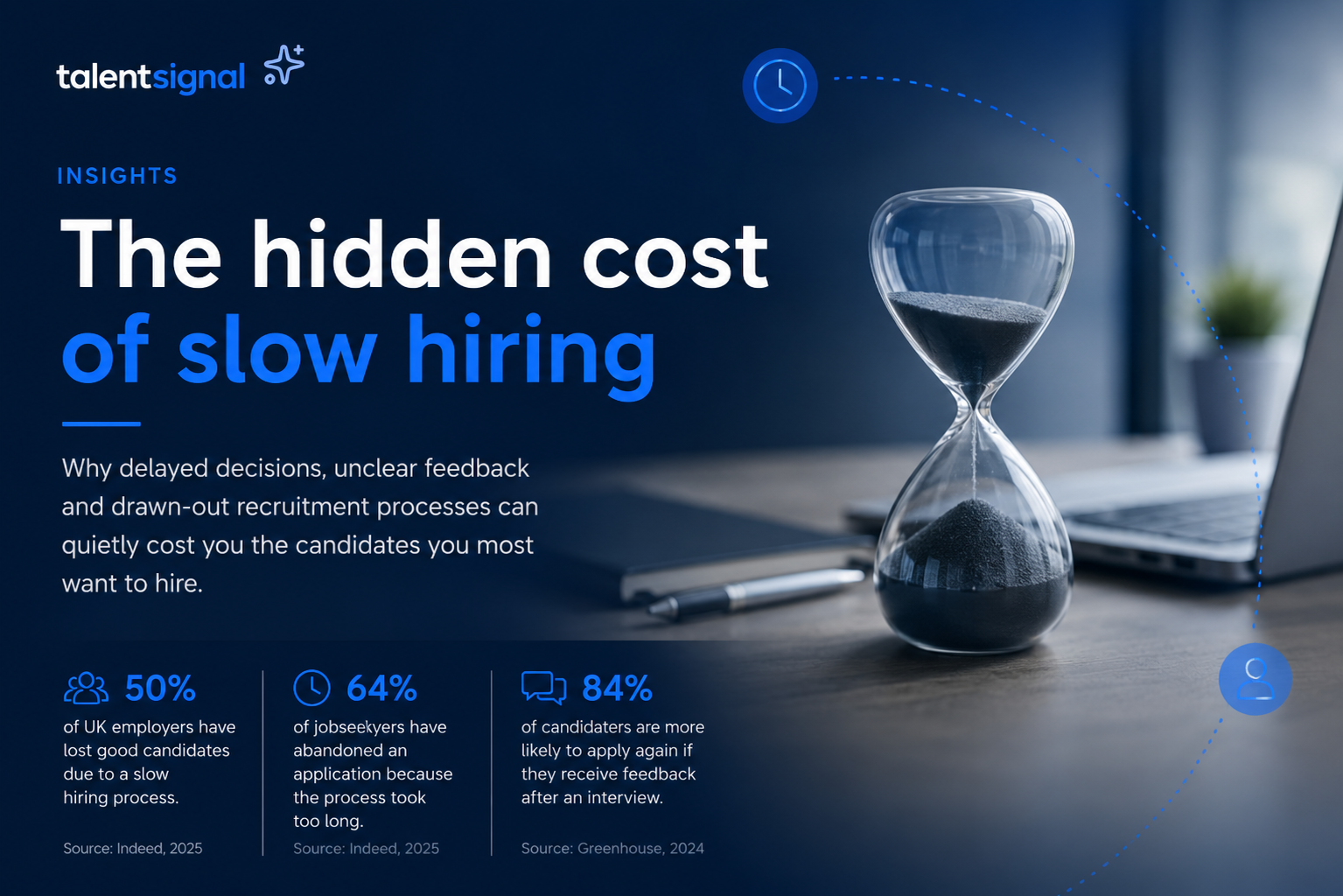
Research from Indeed, reported in September 2025, found that 50% of UK employers said they had lost good candidates because their hiring process dragged on. The same research found that 61% of jobseekers felt the hiring process was inefficient and took too long, while 64% said they had abandoned applications because of the slow pace of the process.
That is a clear warning for employers.
Slow hiring does not just frustrate candidates. It changes their behaviour.
A good candidate may not formally withdraw. They may simply stop engaging with the same energy. They may become less responsive. They may prioritise another process. They may decide the opportunity does not feel worth the uncertainty.
By the time the employer is ready to move, the candidate may already have moved on.
More applicants can create more noise
A softer market can make employers feel they have more choice. Sometimes they do.
But more applicants can also create more noise.
The KPMG and REC UK Report on Jobs for May 2026 reported a further marked increase in candidate availability, with redundancies and lower demand for staff cited as key drivers. At the same time, demand for staff continued to decline, although the rate of contraction was the softest seen for nearly a year.
That combination creates a different type of recruitment challenge.
Employers may receive more applications, but they still need to identify who is genuinely suitable, who is motivated, who understands the role and who is likely to accept if offered. Without a clear process, more applications can slow everything down.
This is where recruitment can become clogged.
The role brief is not sharp enough. The advert attracts too broad a field. Screening takes too long. Interview criteria are unclear. Feedback is inconsistent. The hiring manager wants to see “a few more CVs”. The process extends, but the quality of decision-making does not improve.
That is not a talent shortage problem. It is a process problem.
Slow hiring damages employer brand
The candidate experience is not separate from the employer brand. It is one of the clearest ways a candidate experiences the business before they join.
If the process is clear, responsive and respectful, it builds trust.
If it is slow, vague and inconsistent, it creates doubt.
Indeed’s research found that more than two in five jobseekers said they would be less likely to apply again to a company that fails to respond. Nearly a quarter said they would assume the company was not a good employer if it was unresponsive during hiring.
That should make employers pause.
The people who are not hired still form an opinion. The people who are delayed still remember the process. The people who drop out may still talk about the experience.
This matters even more for employers who need to hire repeatedly in the same market, sector or local area. A poor process can affect future hiring long after one vacancy has closed.
Greenhouse’s 2024 State of Job Hunting report also found that 84% of UK candidates would be more inclined to apply for future roles with a company if they received feedback after an interview, even if they were not hired.
That is a simple but important point.
Communication protects reputation. Silence damages it.
Speed does not mean rushing the hire
A faster hiring process does not mean lowering standards.
This distinction matters.
Employers should not rush unsuitable candidates through a weak process just to fill a vacancy. That creates a different problem. The aim is not to hire quickly at any cost. The aim is to remove unnecessary delay from a process that is already well designed.
Good recruitment needs structure.
The role should be properly briefed before it goes to market. The salary range should be clear. The interview stages should be agreed. The decision-makers should be known. The selection criteria should be understood. Feedback should be timely. Offer approval should not be a surprise at the end.
When those basics are missing, speed becomes difficult because every stage creates friction.
When they are in place, the process can move quickly without becoming careless.
That is the difference between urgency and panic.
Where hiring processes usually slow down
Most hiring delays are predictable.
They usually happen because the employer has not agreed enough before the process starts.
Common causes include:
- unclear role requirements
- salary or flexibility not agreed early enough
- too many people involved in the decision
- interview slots not protected in diaries
- slow feedback after CV review or interview
- uncertainty about what “good” looks like
- late-stage concerns that should have been addressed earlier
- offer approval taking longer than expected
- poor communication with candidates between stages
These issues are rarely solved by advertising the role in more places.
They are solved by better preparation, stronger process management and clearer decision-making.
What employers should do differently
Employers do not need to overcomplicate recruitment to improve hiring speed.
They need to tighten the basics.
1. Agree the brief properly before going to market
A vague brief slows everything down. Before advertising or approaching candidates, employers should be clear on the purpose of the role, the essential requirements, the areas of flexibility and what success will look like.
2. Be realistic about salary and offer
If the salary, flexibility or working pattern is not competitive, this should be understood early. Avoiding the issue does not make it disappear. It usually creates problems later.
3. Decide the process before candidates enter it
Candidates should not be moving through a process that is being invented as it goes. Employers should know the stages, the interview format, the decision-makers and the expected timescales before shortlisting begins.
4. Protect interview time
If hiring matters, interview time needs to be treated as important. Delays often happen because calendars are not managed properly. Good candidates should not be left waiting for weeks because the business failed to protect time.
5. Give feedback quickly
Feedback does not need to be lengthy, but it does need to be timely. Even a clear update is better than silence. It keeps candidates engaged and protects the employer’s reputation.
6. Keep candidates warm between stages
A candidate who is interested still needs communication. A short update, a clear timescale or a check-in can make a significant difference to whether they stay engaged.
7. Make offer approval clear before final interview
If approval is needed, it should be understood before the preferred candidate reaches the end of the process. Delayed offers are one of the easiest ways to lose momentum.
The real cost is losing the candidate you wanted
The most expensive part of slow hiring is not always the time lost.
It is losing the person the business actually wanted to hire.
That candidate may have been interested. They may have been suitable. They may have been open to a conversation. But the process failed to keep them engaged, reassured and confident.
In a market where vacancies are falling, that can feel avoidable. But the data shows that recruitment difficulty has not disappeared. The CIPD’s 2024 Resourcing and Talent Planning report found that 64% of organisations that had tried to fill vacancies experienced difficulties attracting candidates. Senior and skilled roles remained the most challenging.
That is why employers still need to take process seriously.
A cooler market does not remove the need for good recruitment. It simply makes it easier to underestimate the risk.
How TalentSignal can help
TalentSignal helps employers hire permanent staff with more clarity, pace and control.
That means more than sending CVs. It means understanding the role properly, sharpening the route to market, engaging suitable candidates and helping the process move in a way that protects momentum.
If your business is dealing with slow hiring, weak shortlists, candidate drop-off or delayed decision-making, TalentSignal can help you improve the process before good candidates are lost.
The best hiring processes are not rushed.
They are clear, prepared and decisive.
Sources
- Office for National Statistics: Vacancies and jobs in the UK, May 2026
- CIPD: Labour Market Outlook, Spring 2026
- CIPD: Resourcing and Talent Planning Report 2024
- KPMG and REC: UK Report on Jobs, May 2026
- Bank of England: Agents’ Summary of Business Conditions, April 2026
- Onrec: Indeed research on UK hiring urgency and slow hiring, September 2025
- Greenhouse: State of Job Hunting Report 2024
Hiring or exploring your next move?
We're always happy to talk.
Whether you're building a team or thinking about your next role, you can get in touch for a straightforward conversation.